The CISO's Guide to Modern Microsegmentation for Healthcare Organizations
A concise, vendor-neutral blueprint that helps healthcare CISOs stop ransomware from spreading, slash security costs, and fast-track HIPAA-ready segmentation—without breaking clinical workflows.
Download the Guide
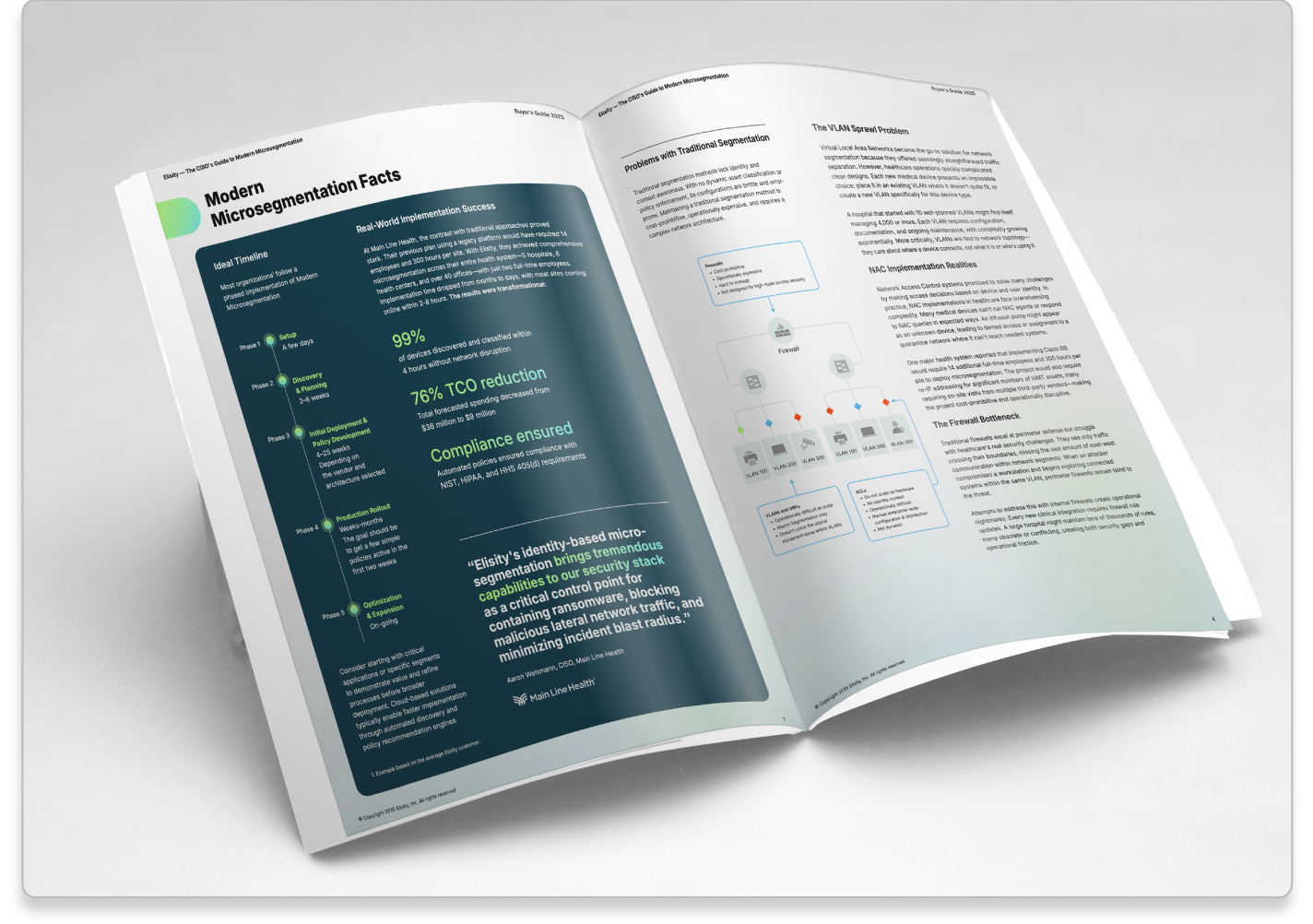
Get Your Comprehensive CISO Playbook for Healthcare Executives
Dive deeper into the critical need for microsegmentation, evaluation criteria, key features, implementation considerations, and how to build a business case. This concise guide distills lessons from leading hospital systems into a 90-day implementation roadmap that you can integrate directly into your Zero-Trust program.
- Step-by-step 90-day roadmap that walks you from Discovery to Policy to Design to Enforcement, with healthcare-specific guardrails.
- Executive-ready ROI framework outlining typical cost- and time-savings proven in recent hospital deployments.
- Deep-dive case studies & CISO interviews that showcase measurable breach-impact and OPEX reductions.
‟Elisity has changed how we look at microsegmentation solutions overall and we have now experienced how Elisity is the easiest to implement and easiest to manage.”
CISO
Main Line Health
What is Microsegmentation?
Identity-based microsegmentation enables organizations to rapidly secure their networks by applying granular, context-aware least-privilege access policies that automatically protect users, workloads, and devices wherever they appear on the network — preventing lateral movement attacks while eliminating the need for new hardware, agents, or complex network reconfigurations.

Why Modern Microsegmentation is Critical in Healthcare Today
- Ransomware attacks target healthcare's lateral pathways—67% of healthcare organizations were hit in 2024, with attackers moving from compromised workstations to critical medical systems.
- Healthcare networks manage 10,000-25,000 connected devices per facility, with 50-70% being medical equipment that can't run traditional security agents and often operate for 10-15 years.
- Healthcare breaches cost $10.93 million on average—the highest of any industry—with 70% involving lateral movement that can disrupt patient care and endanger lives.
- Traditional segmentation approaches fail in healthcare environments where medical devices use proprietary protocols and clinical workflows cross network boundaries that VLANs and firewalls can't effectively protect.
The Business Value of Microsegmentation for Healthcare Organizations
- Reduce Patient Care Disruption: Significantly lower breach impact (typically 90% reduction in blast radius) by preventing ransomware from spreading across clinical systems.
- Lower Healthcare IT Costs: Achieve a 76% reduction in total cost of ownership compared to legacy segmentation approaches requiring extensive VLAN redesigns.
- Faster Medical System Recovery: Decrease mean-time-to-contain from 4-6 hours to under 10 minutes, critical for maintaining patient safety during incidents.
- Strengthen Healthcare Compliance: Simplify audit preparation for HIPAA Security Rule, HHS 405(d), and emerging 2025 network segmentation mandates.
- Potentially Lower Cyber Insurance Premiums: Healthcare-specific security controls can lead to 15%-30% reductions in increasingly expensive medical malpractice cyber coverage.